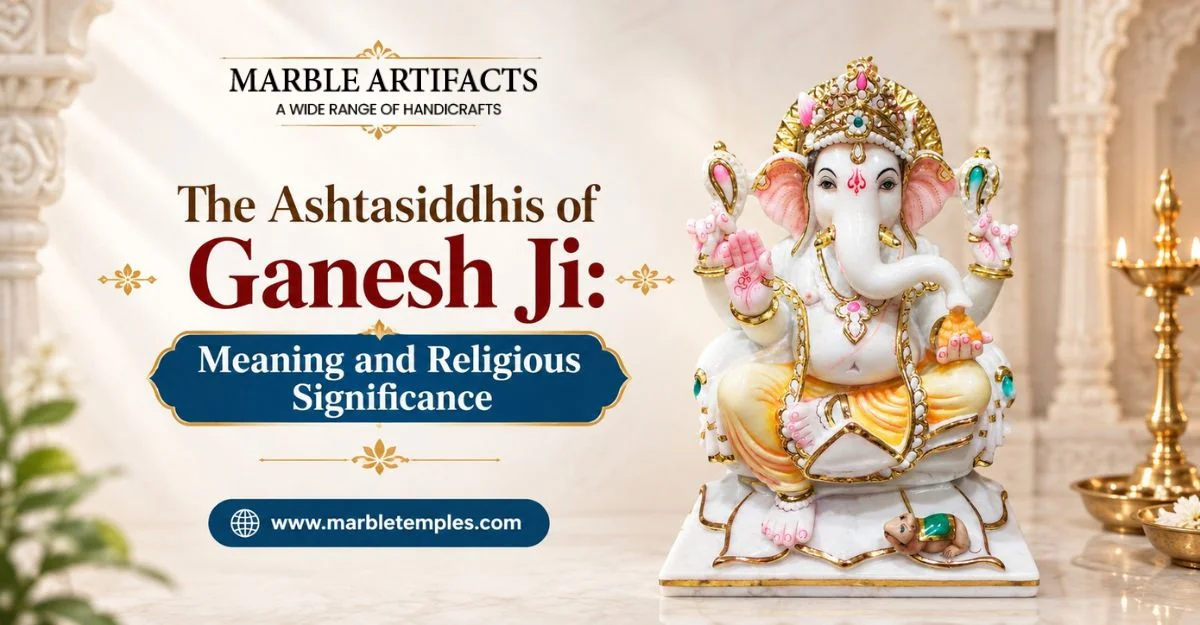
Ganesha is worshipped as the god who removes obstacles and a sign of wisdom, wealth, and good fortune. A marble Ganesh statue is kept in houses, offices, and temples as a sign of respect for Lord Ganesha. In the Hindu spiritual belief system, Ganesha is also related to the Siddhi, which means the attainment of spiritual success or any special power gained spiritually.
Ashtasiddhi is formed by two Sanskrit words, which are "Ashta," which means eight, and “Siddhi,” which means accomplishment, spiritual attainment or extraordinary power. There are eight siddhis in the classical context, which include Anima, Mahima, Garima, Laghima, Prapti, Prakamya, Ishitva, and Vashitva. Various Hindu sources provide different names for these powers. It should be noted that there are other meanings of these powers besides physical abilities.

“Anima” is traditionally described as the ability to reduce to a very tiny size, for example, an atom. Symbolically, it can represent humility and a microscopic perspective on everything.
Mahima is traditionally described as the ability to expand into enormous proportions. Symbolically, it can represent greatness and enlightenment.
"Garima" is traditionally described as the ability to increase weight to a great extent.
Laghima is traditionally described as the ability to be very light or weightless. From a spiritual perspective, it has to do with being free of the excessiveness of the body and burdensome attachments.
"Prapti" is said to mean the ability to attain whatever one wants. In terms of spirituality, it means the accomplishment of something through concentration and dedication.
Prakamya means fulfilling your intentions or desires. It is traditionally associated with the willpower to pursue the chosen goal.
Ishitva is connected to lordship, mastery, and control in traditional terms. Symbolically, its meaning is linked to self-mastery rather than control over other people.
Vashitva is the term that indicates the capacity for control or dominance. Spiritually speaking, it could mean being in charge of one’s senses and actions.
The eight siddhis have been defined in various ways within Hinduism and yoga, and not always with identical interpretations. Traditional texts also point out that the powers are of secondary importance when compared to spiritual enlightenment.
Ganesha is linked to the eight siddhis because of his portrayal in general terms as a god associated with knowledge, achievement, and favorable new beginnings. According to Hindu mythology, the Ashtasiddhis are also shown to be attendants of Ganesha.
Lord Ganesha is also considered a part of the Shiv Parivaar that consists of Lord Shiva and Goddess Parvati, as well as their sons, Lord Ganesha and Lord Kartikeya. The Shiv Parivar marble statue is thus the personification of this divine family and can be displayed in temples, home temples, and other devotional spaces. The portrayal of the Shiv Parivaar is very important for the devotees, as it is a symbol of many qualities of the holy family in one artwork.
The white marble is highly appreciated because of its brightness and the way it can bring out intricate carvings. The white marble Ganesh statue will enable one to bring out details like the trunk, crown, accessories, and hands while still giving a peaceful look. According to Marble Temple, it manufactures marble god statues and sculptures which have been carved, polished, and painted, with choices being white marbles. The marble items are sold all over India and even internationally. For those looking for reliable marble statue manufacturers in Jaipur, the city is also known for its skilled artisans and traditional marble craftsmanship.
The Ashtasiddhi theory provides yet another dimension to the symbolism that is attached to the worship of Lord Ganesha. The eight Siddhis can be interpreted traditionally as the various forms of achievement on the spiritual path, whereas the inclusion of Ganesha symbolizes knowledge, devotion and overcoming obstacles. It is important for devotees not only to aspire for special abilities but also to develop certain inner virtues, including self-discipline, learning, and concentration.
Ashtasiddhi refers to the eight traditionally described spiritual attainments or powers found in Hindu and yogic traditions. The presence of Ashta siddhis with respect to Lord Ganesha indicates success, knowledge, discipline, and mastery. Therefore, an appropriately carved marble statue of Ganesha could signify both faith and the artistic legacy of marble sculptures in India.